
Kittitas County Sex Offender Checks
A sound Kittitas County registry check uses more than one official view. Begin with the Washington Sex Offender Information Center, which provides the public search entry for Washington. Then compare the Kittitas County Sheriff's sex offender page. The county explains how Level I, II, and III disclosure works and publishes the locally authorized public information. These channels answer related but different questions. WASPC is the state search layer. KCSO is the local registration and notification authority.
Before searching, collect a full name, likely city, ZIP code, and any known physical details. Name spelling matters. An address search can help with neighborhood awareness, but it should not be treated like real-time tracking. People move, reporting updates take time, and some information is withheld under Washington's risk-based disclosure rules. Record the date, radius, and terms used so a later search can be compared fairly.
Kittitas County Registration Desk
Kittitas County residents who must register report to the Sheriff's Office at 307 W Umptanum Road in Ellensburg. The registration counter is open weekdays from 9:00 a.m. to 5:00 p.m., excluding holidays, and the main number is 509-962-7525. Registrants should bring identification plus the conviction date, place, and offense information. KCSO fingerprints and photographs the registrant as part of its local process.
The official Kittitas County registration page shows the local office and its risk-level framework.
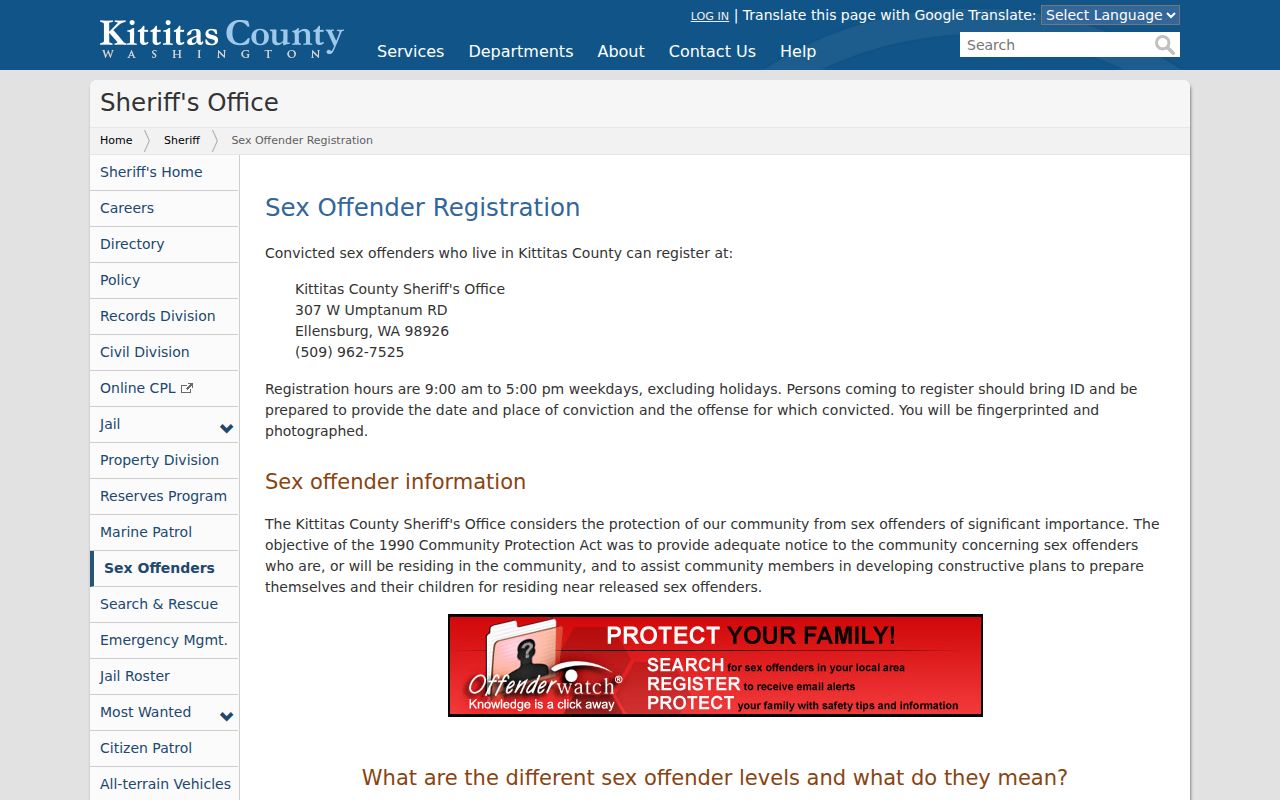
This county view matters because it explains why Kittitas County may provide a public Level III profile while handling Level I or Level II information through narrower notification channels.
Kittitas County Sheriff's Office
Sex Offender Registration
307 W Umptanum Road
Ellensburg, WA 98926
509-962-7525
Monday through Friday, 9:00 a.m. to 5:00 p.m., except holidays
Washington Sex Offender Public Registry Searches
The Washington Sex Offender Public Registry, also presented through the WASPC Sex Offender Information Center, supports name and geographic searching where the live interface makes those choices available. Use a focused query first. Broad map results can create false matches when names, streets, or city labels resemble each other.
- Open the official WASPC search entry and read the conditions of use before accepting them.
- Choose a name search or an address-based search. Enter only the fields you can support with reliable facts.
- Filter to Washington and Kittitas County, or use Ellensburg, Cle Elum, Kittitas, or a ZIP code when the interface offers that field.
- Open a possible profile and compare the name, photograph, physical description, offense, and displayed locality before treating it as a match.
| Field | Type | Required | How to use it |
|---|---|---|---|
| Search method | Tabs or choices | Yes | Select name or geographic/address search when supported. |
| First and last name | Text | Search-dependent | Spelling matters; use both when known. |
| Address | Text | Geographic search | Centers an address or map-based search. |
| City, ZIP, county | Text or dropdown | No | Narrow to a Kittitas County locality. |
| State and radius | Dropdown | Interface-dependent | Choose Washington; live radius choices may change. |
| Terms or CAPTCHA | Checkbox | When shown | Acknowledge lawful-use terms before searching. |
The WASPC registry interface places the statewide search beside official cautions.
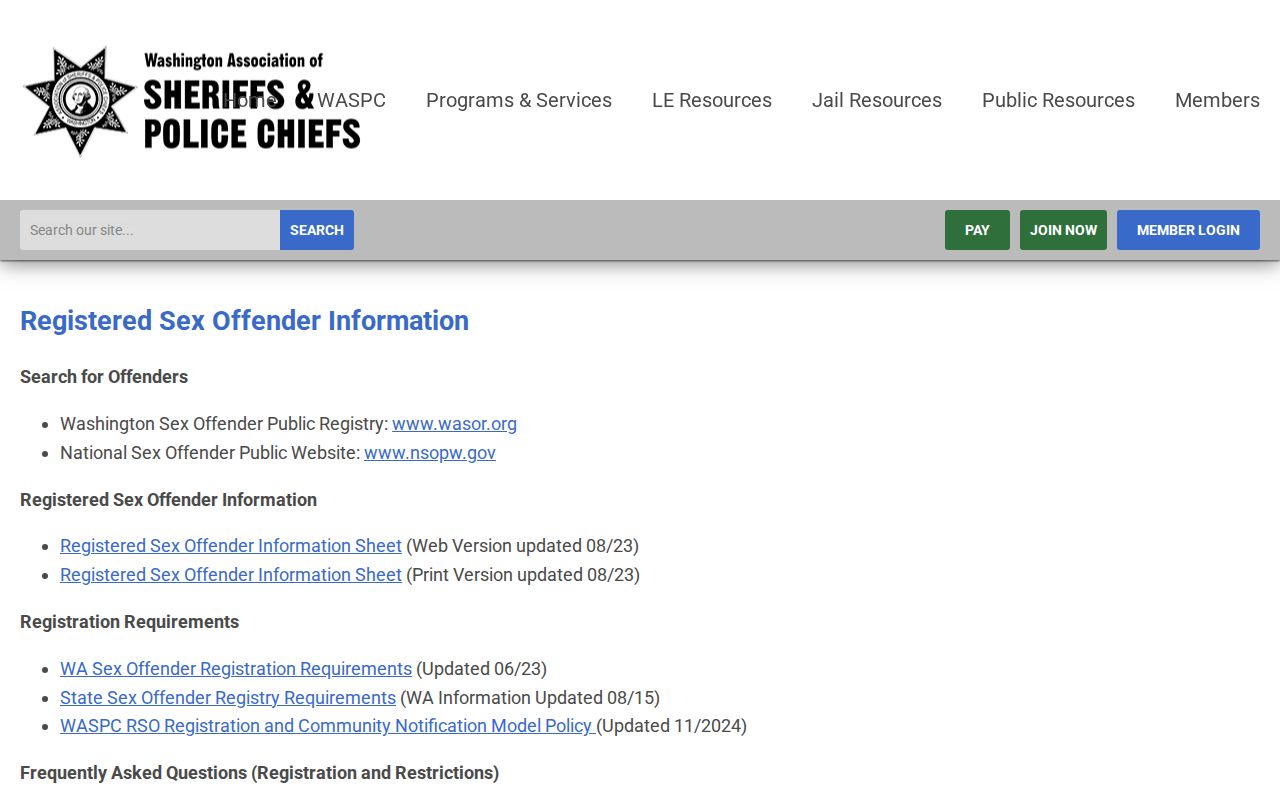
The image reinforces that the search and its limits belong together. Read the warning before relying on a result.
Missing Kittitas County Registry Names
A no-result screen is not proof that no registration duty exists. First, retry reasonable name spellings and remove optional filters that may be too narrow. Next, search by the last known address or locality. Compare the county page, since KCSO may explain the available notification level. If interstate movement is possible, search NSOPW. For a suspected compliance issue, call law enforcement instead of trying to locate or confront a person.
Washington does not disclose every level in the same way. Level I information generally is not released through broad public notification. Level II disclosure may go to qualifying schools, child-care providers, organizations, neighbors, or community groups when the statutory standard is met. That limited release can explain why a person known to law enforcement is not shown in a general public result.
Registry Profiles: What They Show
A Kittitas County public profile is an identity and notification record, not the underlying court file. Compare multiple fields before deciding two records refer to the same person. The county layout may show a street, block, or transient locality depending on what public release is authorized. It does not promise a full date of birth, victim details, employer, school, or all conviction papers.
| Identity | Full name, and aliases when authorized by the state or vendor profile. |
|---|---|
| Photo and description | Photograph, age, race, sex, height, weight, hair color, and eye color. |
| Location | Street, block, or transient locality at the level permitted for public notice. |
| Offense | Offense descriptions and, on some profiles, conviction jurisdiction, date, or statute. |
| Other authorized data | Scars, marks, tattoos, vehicle details, registration status, or compliance data when releasable. |
| Not included | Victim data and a guaranteed live address; use the court file to verify the judgment. |
Note: Match a photograph, physical facts, offense, and locality together; one shared name is too weak to confirm identity.
Kittitas County Registry Address Limits
Address and radius tools are useful for safety planning, but the map is not a live location feed. A displayed address reflects registration information available to the system when it was updated. It can lag a move, use block-level wording, or identify a transient locality rather than a residence. Searchers should save the query date and avoid turning a map pin into a claim about where someone is at that moment.
For a public-safety concern, give KCSO the profile name, displayed location, and reason for concern. The office can decide whether a compliance check or referral is warranted. Do not trespass, follow anyone, post threats, or conduct an amateur investigation. Those acts create risk and are outside the purpose of community notification.
Registration Levels and Duties in Washington
Washington risk levels describe assessed risk and the reach of public notification. They do not set registration duration by themselves. Duration is tied to the conviction, statutory category, prior covered convictions, age in some juvenile cases, jurisdiction, and time spent in the community. Calling Level II an automatic fixed-term tier, for example, would confuse state risk labels with federal tier shorthand.
| Washington level | Public notification | Registration duration |
|---|---|---|
| Level I | Low risk; generally limited, targeted disclosure rather than broad public notice. | Set by the conviction and statute, not Level I alone. |
| Level II | Moderate risk; targeted notice may reach qualifying groups and nearby community members. | Offense-dependent, not automatically 25 years. |
| Level III | High risk; notice to the public at large may be permitted. | Offense-dependent and may be indefinite for qualifying cases. |
Under RCW 9A.44.140, qualifying adult class A offenses and covered offenses with a prior covered conviction generally carry indefinite registration. Eligible class B cases with no covered prior may end after 15 consecutive qualifying community years, while eligible class C or named attempt or conspiracy cases may end after 10. Separate juvenile and relief rules apply. Only a review of the actual judgment and current statute can answer an individual's duration question.
Juvenile duties use different periods. Covered class A conduct committed at ages 15 through 17 generally carries three years, while other covered juvenile conduct generally carries two. Federal, tribal, and out-of-state duties can remain indefinite unless current law grants relief. Time in the community and a later relief order can also affect the end date, so Kittitas County searchers should never infer a duty from the public risk label alone.
NSOPW Kittitas County Registry Searches
The National Sex Offender Public Website sends one query to participating jurisdictions. It is the right added layer when a person may have moved between states, tribal lands, or territories. NSOPW does not erase local disclosure rules, reporting delays, or name-match limits. A national no-result should be read with the same care as a Washington no-result.
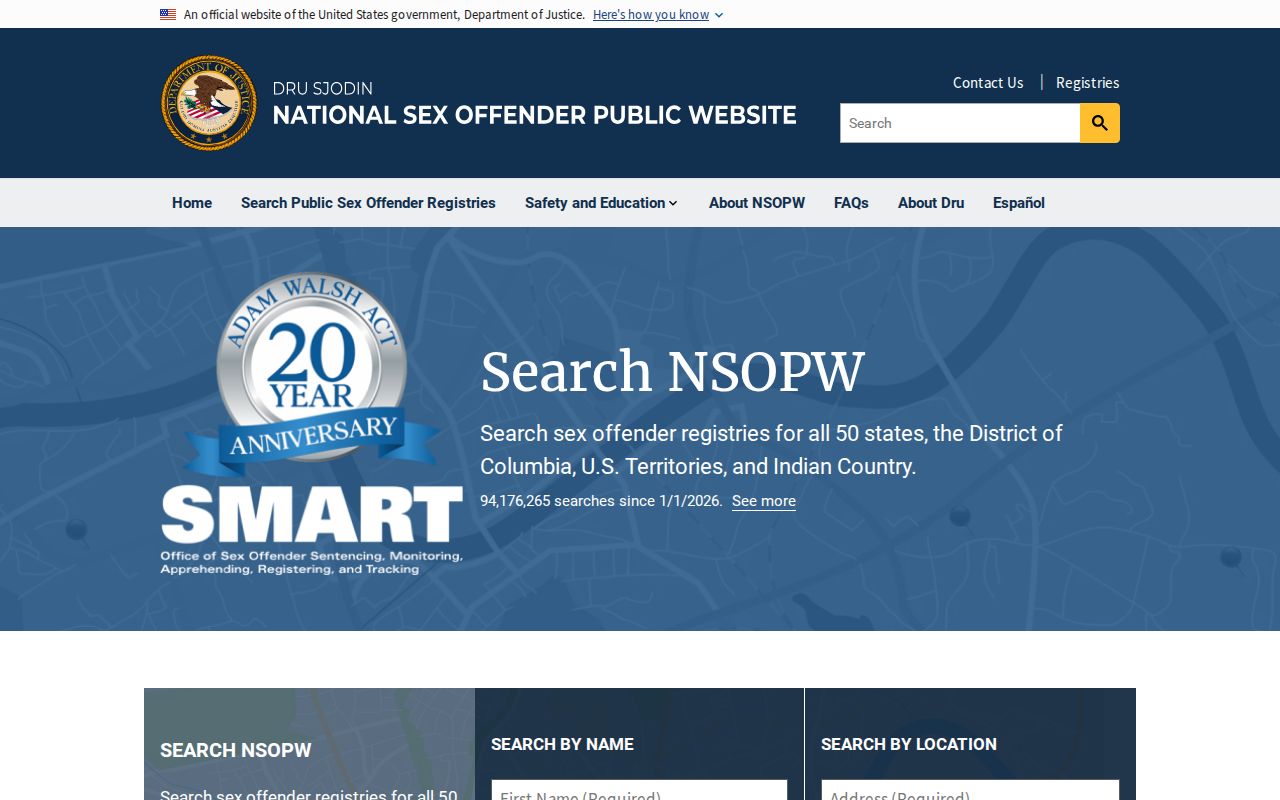
This broader interface extends the geographic reach of a Kittitas County search, while KCSO remains the best contact for local registration and suspected noncompliance.
Report Kittitas County Registry Noncompliance
Suspected failure to register belongs with law enforcement. Write down the profile name, the public information at issue, the date you searched, and the facts that caused concern. Then call KCSO at 509-962-7525. Use 911 only for an immediate emergency. Do not contact the registrant or household, and do not publish an accusation based on an uncertain match.
This route keeps the response with officers who can check restricted records and current registration data. The public cannot see every verification fact or investigative step. A careful report supplies facts without assuming guilt, while KCSO determines what action the law permits.
Using Registry Information Lawfully
Community notification under RCW 4.24.550 supports awareness and practical safety planning. Kittitas County uses risk-based release, so the audience and detail may vary by level. Public access does not authorize harassment, threats, vigilantism, property damage, or unlawful discrimination. If a profile raises a concern, verify the match and contact law enforcement.
The Washington community-notification statute defines the legal setting for release and misuse limits.
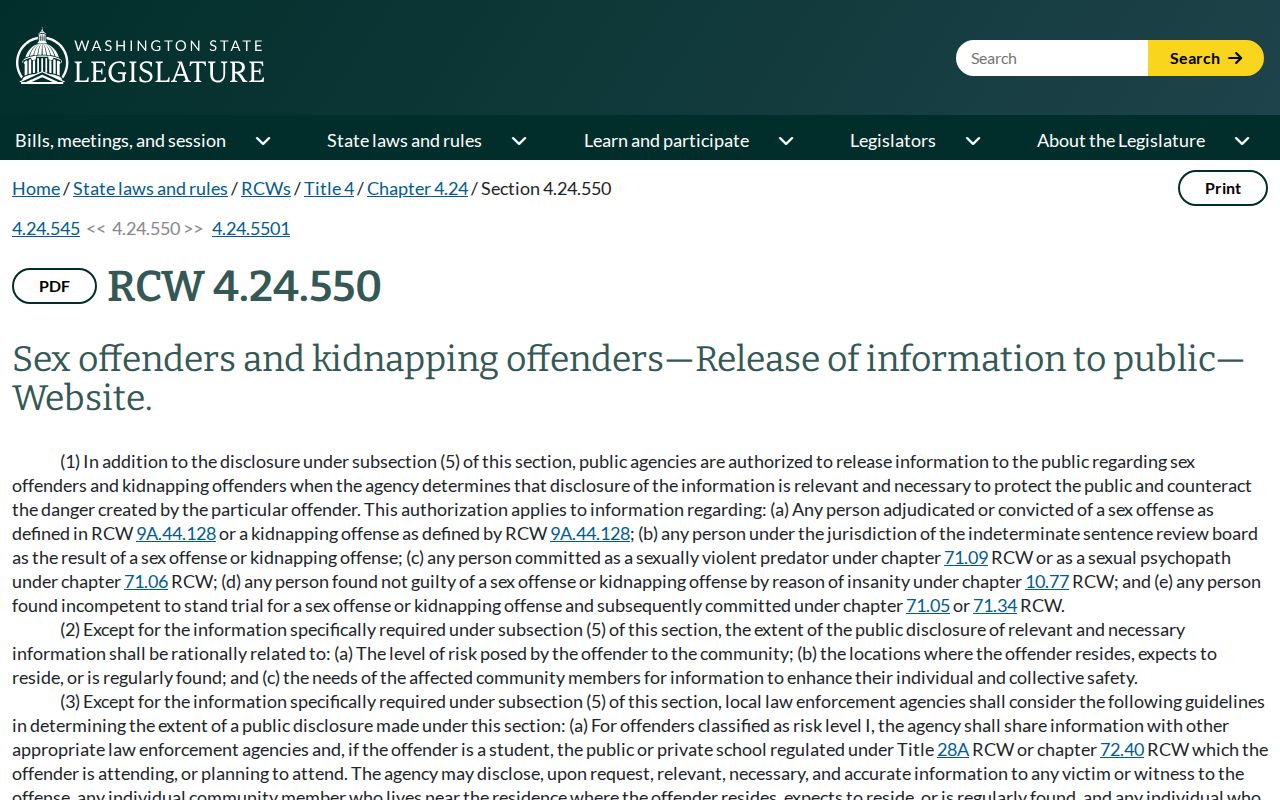
The statute supports risk-based notice while leaving enforcement and compliance work to trained officials.
Misuse can lead to arrest or prosecution: RCW 4.24.550 does not authorize threats, harassment, violence, vandalism, or vigilantism against a registrant or family. Report concerns to law enforcement.